ECR Sustainability Webinar Series 2026
The Business of Ageing: Rethinking Retail for Tomorrow's Consumers
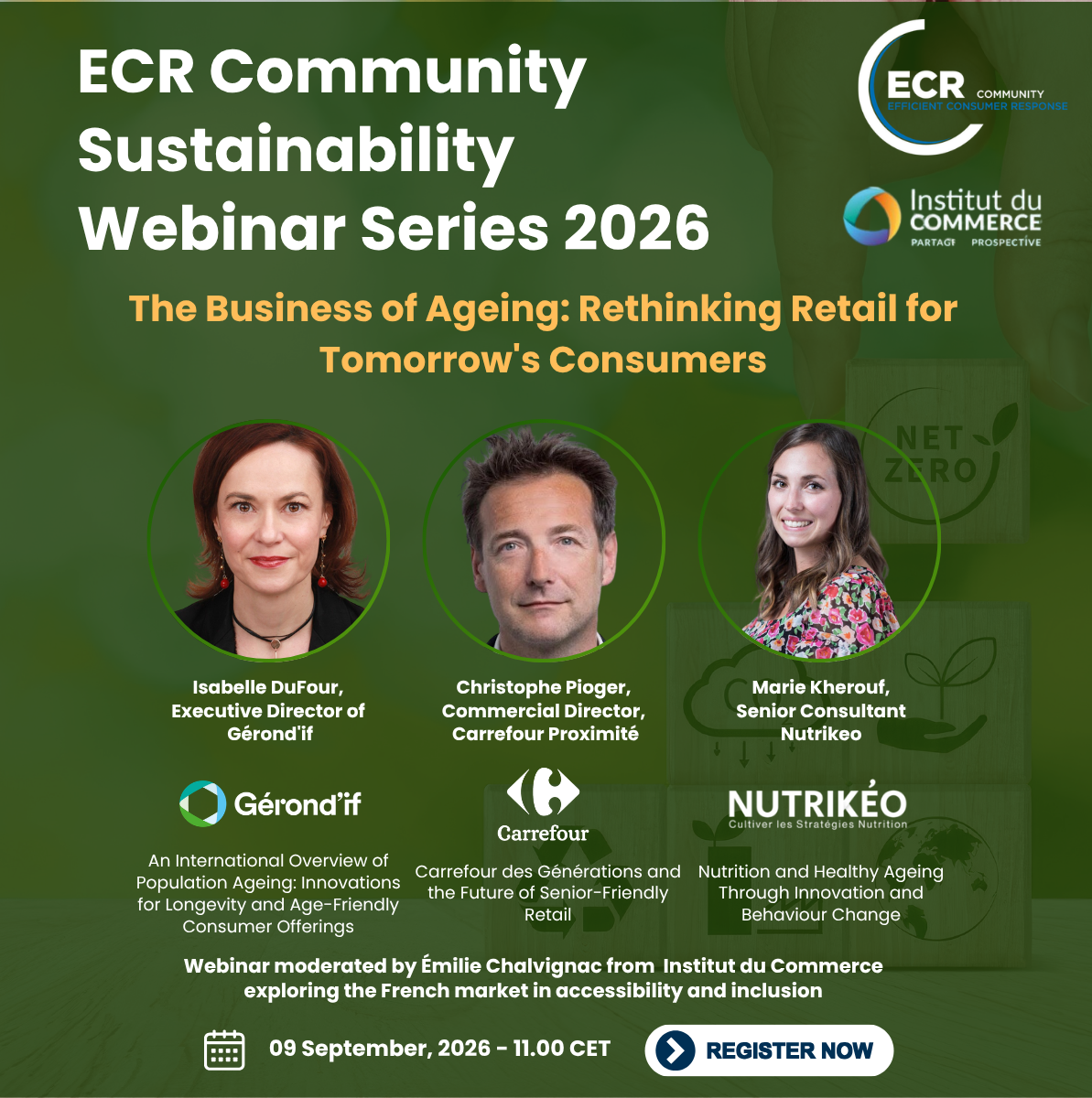
As part of the ECR Community Sustainability Webinar Series 2026, industry experts gathered on 9 September to explore how businesses can respond to one of the most significant demographic shifts of our time: population ageing. Moderated by Émilie Chalvignac from Institut du Commerce, the webinar brought together perspectives from science, nutrition and retail to examine how companies can better serve the growing longevity economy.
Population Ageing: A Global Opportunity for Innovation
Isabelle Dufour, Executive Director, Gérond'if
Opening the webinar, Isabelle Dufour explored the profound demographic changes transforming Europe and the opportunities they create for businesses. With nearly one-third of Europeans expected to be over 65 by 2050, she highlighted the emergence of the "longevity economy" and the growing influence of older consumers on spending and purchasing decisions.
A central theme of the presentation was the need to change the way society and businesses view ageing. Today's older adults are healthier, more active, more connected and more demanding than previous generations. Rather than being seen as a vulnerable group, they should be recognised as a strategic consumer segment with diverse expectations and significant market influence.
Isabelle also introduced the concept of "Retail for Longevity", encouraging retailers to move beyond accessibility and towards truly inclusive experiences. She outlined how retail can contribute to healthier ageing by promoting better nutrition, supporting social connection, encouraging healthier choices and designing products and services that adapt to changing abilities without stigmatizing consumers. The presentation concluded with a call for retailers, researchers and policymakers to work together to create environments that help people live longer, healthier and more connected lives.
Carrefour des Générations: Adapting Retail for an Ageing Population
Christophe Pioger, Commercial Director, Carrefour Proximité
Christophe Pioger presented the Carrefour des Générations initiative, a practical example of how retail can respond to the changing needs of ageing consumers. Developed around the ambition of becoming the preferred store for seniors, the programme places service, accessibility and human interaction at the heart of the customer experience.
The initiative is built around four pillars: merchandise, customer care, services and relationships. Christophe explained how dedicated product selections, clearly identified in stores, help customers easily find relevant products while improving operational efficiency. He also shared examples of tailored services including home delivery, in-store assistance and ergonomic shelf placement designed to make shopping easier and more comfortable for older customers.
Beyond physical accessibility, the programme recognises the importance of social connection. Activities such as the "Café des Générations" and other intergenerational events create opportunities for customers to engage with store teams and local communities. Through these initiatives, Carrefour demonstrates how retailers can go beyond transactions and play a meaningful role in supporting wellbeing, inclusion and community engagement among older consumers.
Nutrition and Healthy Ageing Through Innovation and Behaviour Change
Marie Kherouf, Senior Consultant, Nutrikéo
In the final presentation, Marie Kherouf examined the role of nutrition and innovation in supporting healthy ageing. She highlighted that older consumers are a highly diverse population, with varying levels of independence, health conditions and nutritional requirements. As a result, solutions must be increasingly personalised and adaptable to different needs.
Marie outlined several of the challenges associated with ageing, including undernutrition, oral health issues, changes in taste and smell, cognitive decline and social isolation. These factors can have a significant impact on food choices and quality of life, creating opportunities for businesses to develop products and services that better support older adults.
The presentation showcased examples of innovation already emerging across markets, including texture-modified foods, fortified products, personalised nutrition programmes and technologies designed to help older adults maintain independence. At the same time, Marie stressed that nutritional adaptations should never come at the expense of taste and enjoyment. She concluded by emphasising that the future of healthy ageing will require a combination of nutrition, technology and supportive environments, with a strong focus on individual needs and maintaining quality of life.